Robotic arms capture the imagination—lifting, grasping, and placing objects much like industrial robots. The Robocraze DIY Robotic Arm Kit is designed to teach students the mechanics behind robotic manipulators while also introducing control through servos and simple code. For MAK Technology, this kit is perfect for a focused unit on kinematics, control, and engineering design.
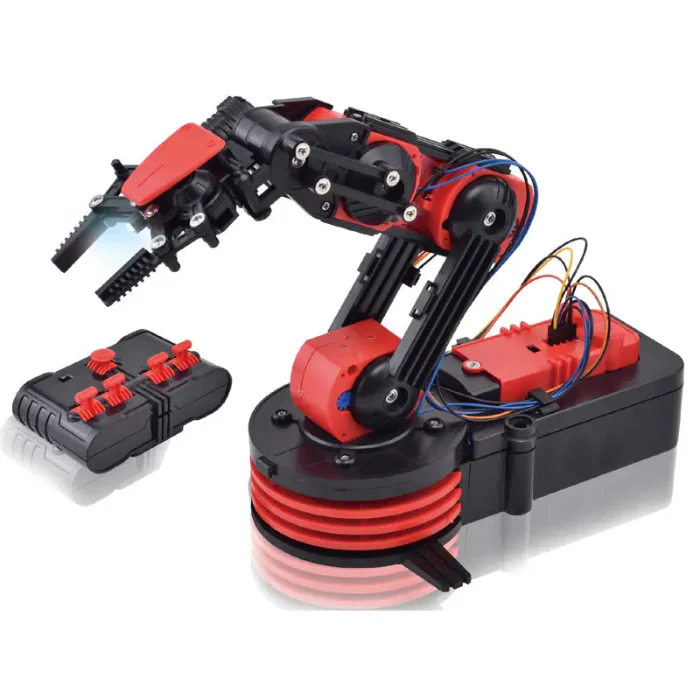
Common components include servo motors (often 4–6), structural parts (plastic or metal), linkages, gripper assemblies, screws and mounting hardware, control board, and sample code. With these, learners practice:
Linkage geometry: Understanding how arm length and joint placement affect workspace.
Servo control: PWM control, torque considerations, and calibration.
Gripper design: Simple mechanisms for grasping different shapes.
Programming sequences: Recording and replaying motions, and creating procedural tasks.
Divide learning into modules:
Assembly & mechanics: Build the arm, learn joints and links.
Servo basics: Calibrate servos, measure range of motion, torque testing.
Kinematics basics: Introduce forward kinematics and workspace mapping (simplified).
Programming tasks: Pick-and-place sequences and error-handling (if an object is missed).
Design challenge: Modify gripper or arm to handle an unusual object.
Great for ages 9–14. Students who enjoy hands-on mechanical work and logic puzzles will thrive. This kit complements broader robotics modules at MAK Technology—especially when teaching physical automation principles.
Precision pick-and-place contest: Who can program the fastest, most accurate arm?
Factory line demo: Simulate a small production line with sorting tasks.
Creative gripper challenge: Design a gripper for fragile objects like eggs or paper cups.
Use step-by-step worksheets for assembly.
Include short experiments showing how changing arm lengths affects reach.
Pair mechanical students with programming students to encourage teamwork.
Pros: Deep hands-on mechanical learning; excellent for applied physics and robotics.
Cons: Limited mobility (stationary arm), requires careful servo selection for payloads.
A robotic arm kit like Robocraze’s is excellent to include in MAK Technology’s curriculum for focused mechanical robotics training. Want a 6-week lesson plan and assessment rubric ready to go? I’ll draft one tailored to your class size and skill levels.
WhatsApp us